

Overview
Bwindi Impenetrable National Park (BINP) covers an area of 321 km² between 1,160m and 2,607m above sea level. Bwindi was gazetted as a National Park in 1991 and declared a UNESCO Natural World Heritage site in 1994. The Mubare gorilla group at Buhoma was the first to be habituated for tourism in Bwindi in April 1993.
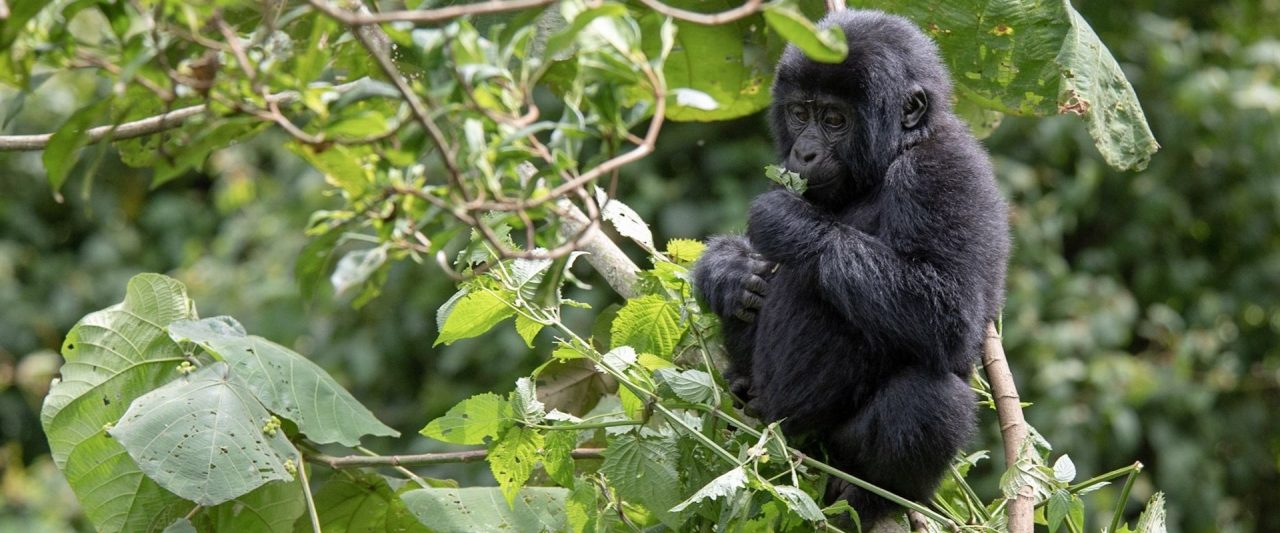
A total of fifteen groups have now been habituated for tourism and are tracked from four trailheads. Uganda’s foremost tourist attraction, and indeed one of the world’s most remarkable wildlife encounters, is tracking mountain gorillas through the remote Bwindi Impenetrable forest of south-western Uganda. These magnificent apes are both rare and endangered; their total population numbers less than 800 animals divided between the forests of Bwindi Impenetrable and the nearby Virunga volcanoes. With fifteen groups habituated for tourism, the Impenetrable Forest is the world’s primary mountain gorilla tracking destination.
There is however much more to Bwindi than gorilla tracking. Forest trails lead to scenic waterfalls and rift valley viewpoints while community walks through local villages provide insights into the lives of the Batwa (Pygmy) and Bakiga people living beside the forest. Bwindi is also one of Uganda’s top birdwatching destinations with many Albertine Rift endemics present, notably in the high, draughty Ruhija sector.

One of Africa’s oldest and richest forests – one of few that predate the arid conditions of the last ice age, 12,000-18,000 years ago – the Bwindi Impenetrable has been weaving itself into tangles across the fissured and folded margin of the Albertine Rift Valley for some 25,000 years. In the process it has accumulated a remarkable biodiversity, thanks also to an 1147m altitudinal range that accommodates habitats ranging from lowland forest at 1,160m to rare Afromontane vegetation above 2,600m. Species counts include 310 butterflies, 88 moths, 200 trees, 51 reptiles and 120 types of mammal. The latter includes several primates, among them chimpanzees, blue monkeys, L’Hoest’s monkey, and, the star of the Impenetrable show; the mountain gorilla.
Bird life is also exceptionally rich with 357 species dominated by forest birds. These include 23 endemics (90% of all Albertine Rift endemics) such as the short-tailed warbler, Shelley’s crimson wing, African green broadbill and the blue-headed sunbird, and seven IUCN Red Data List species. Fourteen species, including the brown-necked parrot and the white-bellied robin chat, occur nowhere else in Uganda.

Best Time to Visit
Bwindi is open for gorilla trekking all year long, but the best times to go are from June to August and December to February. At these times, the forest trails are drier and therefore less slippery. Also, your chance of a dry gorilla viewing experience is higher during these months. This might result in a better experience and photography will be easier.
Check out these
Awesome Tours
- Area:
- 321 km²
- Elevation:
- 1160 m to 2607 m
- Founded:
- 1991
- Mammals:
- 120
- Birds:
- 357 species
- Butterflies:
- 310